W★rlf: terrain lift, and how it joins thermals
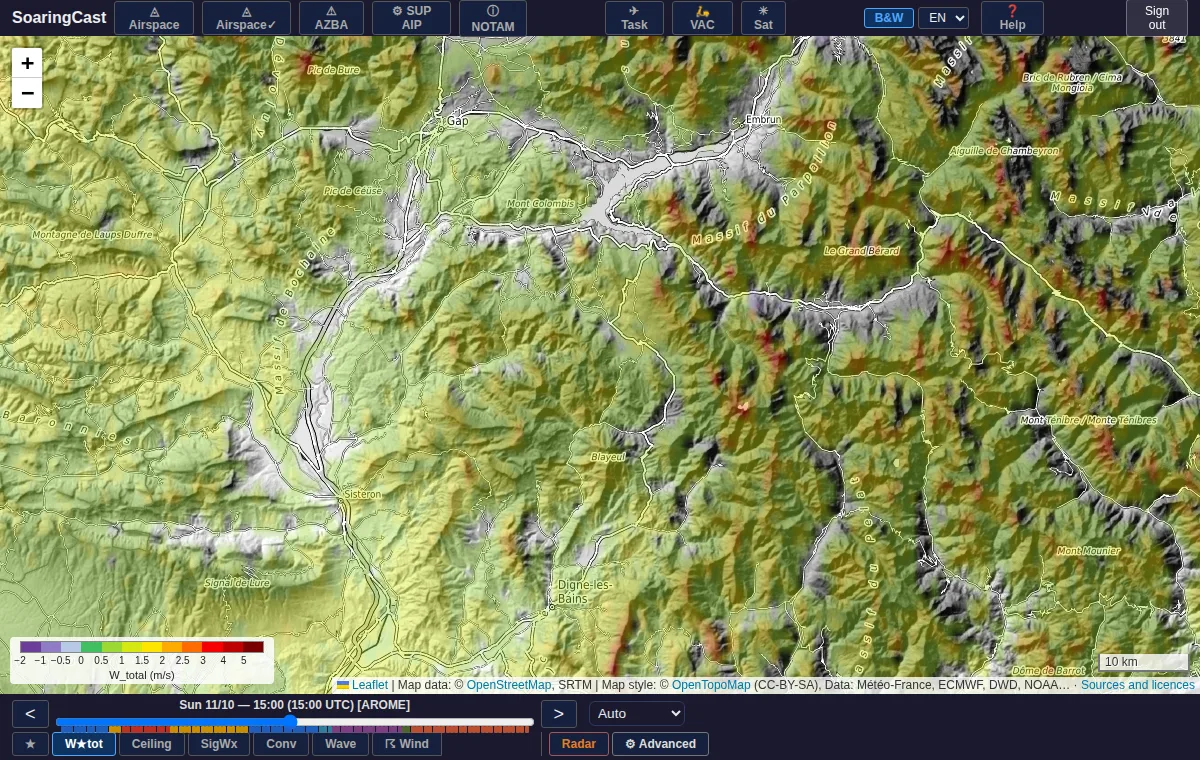
Over flat land, thermal strength depends mostly on the sun and on the depth of the convective layer: that is W★. In the mountains, that is not enough. A well-exposed slope heats more than flat ground, slope thermals meet on the ridges, wind striking a slope rises, and valley floors are sometimes stable. W★rlf expresses these terrain effects. The W★tot map puts it all together.
What makes up W★rlf
- Slope heating: the main effect. A slope receives more or less sun depending on its aspect, its steepness and the time of day. Only direct sunshine counts: the diffuse light of a hazy sky heats everything alike and is already in W★.
- Ridges: this is where slope breezes and thermals from both sides meet. This boost comes from the sun alone: without slope heating there is no ridge bonus, and wind plays no part in it.
- Wind on the terrain: facing the wind, the slope adds dynamic lift. In the lee, it takes some away.
- Valley floors: W★rlf can carry a negative term there that offsets an optimistic W★, all the stronger as the valley is deep. It represents the sinking air that compensates for thermals rising along the slopes. It therefore follows convective activity: zero at sunrise and sunset, delayed in the morning like slope heating, and cancelled under overcast skies.
What it is sensitive to
- Time of day: east faces in the morning, west faces in the evening. The ground stores heat, so the peak comes in mid-afternoon and the end of the day stays fed. Terrain lift does not switch on at sunrise: it waits until convection over the plains has started.
- The sky: under hazy or overcast skies, the difference between slopes fades.
- Snow: a snow-covered slope heats much less.
- Strong wind: it gradually switches off the whole thermal effect, good and bad alike.
- Flat land: W★rlf is close to zero there, and W★tot equals W★.
How it joins W★ in W★tot
You might think thermals and terrain lift are added. They are not: both draw on the same energy, the sun's, and adding them would count it twice.
- Where the terrain lifts, the stronger of the two is kept.
- Where it sinks (valley floor, lee side), it trims convection.
- Wave and convergence can only raise the total, where they are stronger than the rest.
W★tot can therefore be negative: the map then shows where the air is sinking.
Create an account to access the map, soundings and the dashboard.
Create an account