The ★ rating: what raises it, what lowers it
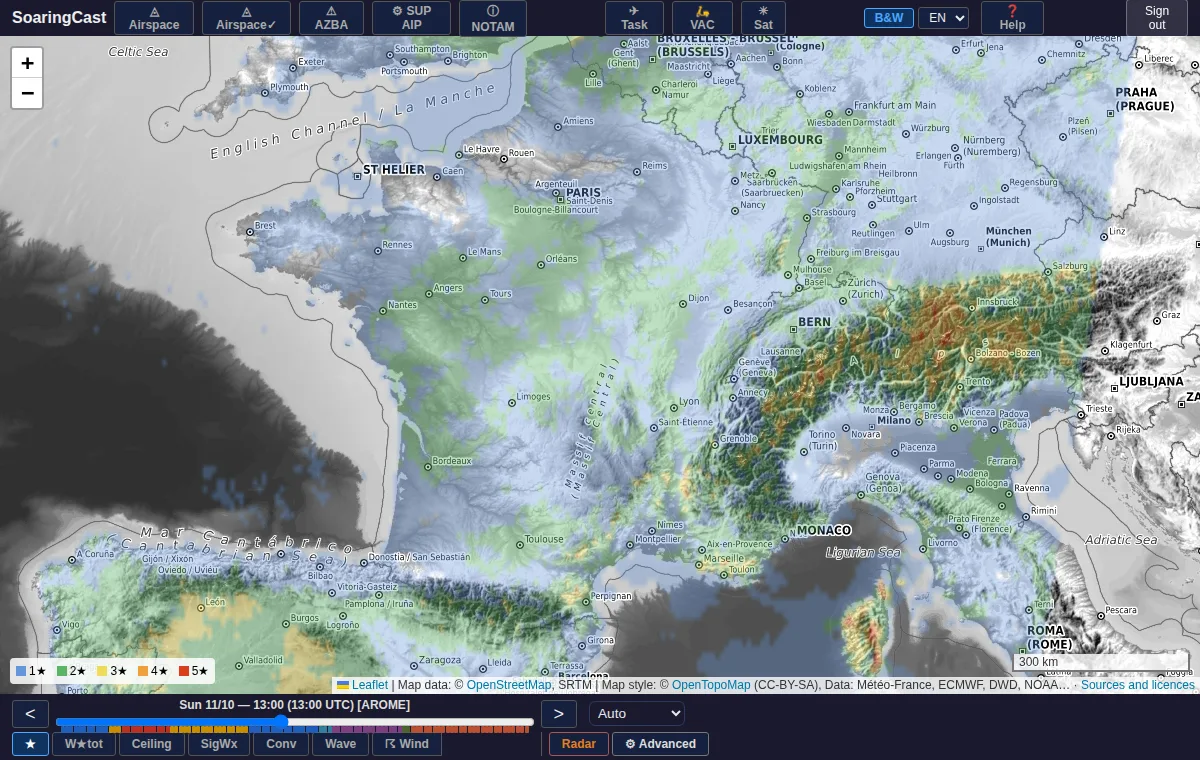
The ★ rating sums up a soaring day in 0 to 5 stars, anywhere on the map. It is a first sort to find the best area to fly. Knowing what it responds to helps you read it, and above all tells you when to be wary of it.
The two pillars: duration and strength
The rating rests first on two quantities of equal weight:
- usable duration: the number of hours when lift is good enough to stay up. The hours need not be consecutive: a day cut in two by a cloudy spell keeps both halves;
- the strength of the lift during those hours, measured by W★tot: thermals, terrain lift, and wave or convergence where they are stronger (see the article on W★rlf).
A day that is too short gets no star, even if its thermals are strong.
Ceiling matters, but less than you think
The usable height above ground raises the rating, but less and less: doubling the ceiling is far from doubling the rating. A long, steady day with an average ceiling therefore often beats a short day with a very high one. The ceiling is measured above ground.
Wind: neutral, then penalising
The wind used is the one at the height where you fly. Below a certain threshold it has no effect. Above it, it lowers the rating more and more, until it wipes it out completely in very strong wind. A fine thermal day may thus show only one or two stars on a windy day.
What only plays indirectly
- Clouds: they reduce sunshine at the ground, and so the strength of thermals. That is how, and the only way, they lower the rating.
- Moist air lowers the cumulus base, and so the ceiling.
- Blue thermals: without cumulus, the ceiling used is taken a little below the top of the convective layer, where thermals remain usable. With cumulus, the cloud base sets it, if it is lower.
What the rating does not see
- Thunderstorms and showers: the rating has no penalty for showers. A day with a high thunderstorm risk can show a good rating. For that risk, look at the SigWx map and the CAPE in the sounding.
- Airspace and active areas.
- Your glider and your level: the rating describes the air mass, not what you will do with it. For that, there is the task simulation.
When to be wary
- When the model changes: beyond D+1, then D+4, other models take over with coarser grids, and some do not provide every parameter. A rating that jumps from one day to the next may come from that change rather than from the weather.
- When models disagree: the “Model spread” gauge in the dashboard shows it. A good rating with a large spread is worth checking again at the next update.
- Map and dashboard can differ by one star in places: they do not work at the same resolution.
Create an account to access the map, soundings and the dashboard.
Create an account